How does an electronic neuron work? What can a tiny tissue model reveal? And how does information find its way back to a person?
Explore four more layers of the connection between biology and intelligence. From the mechanism inside a chip to the feedback that makes a system useful.
Independent research. Our development direction remains at the concept stage.
01 / NEUROMORPHIC COMPUTING
Computing that follows the event.
A signal does not always need to be processed as an uninterrupted stream. Neural-inspired electronics explores what happens when discrete events carry the information.
SPIKING NETWORKSEVENT-DRIVENEDGE COMPUTING
01 / NEURAL-INSPIRED ELECTRONICS
THE MECHANISM
Events, states, connections
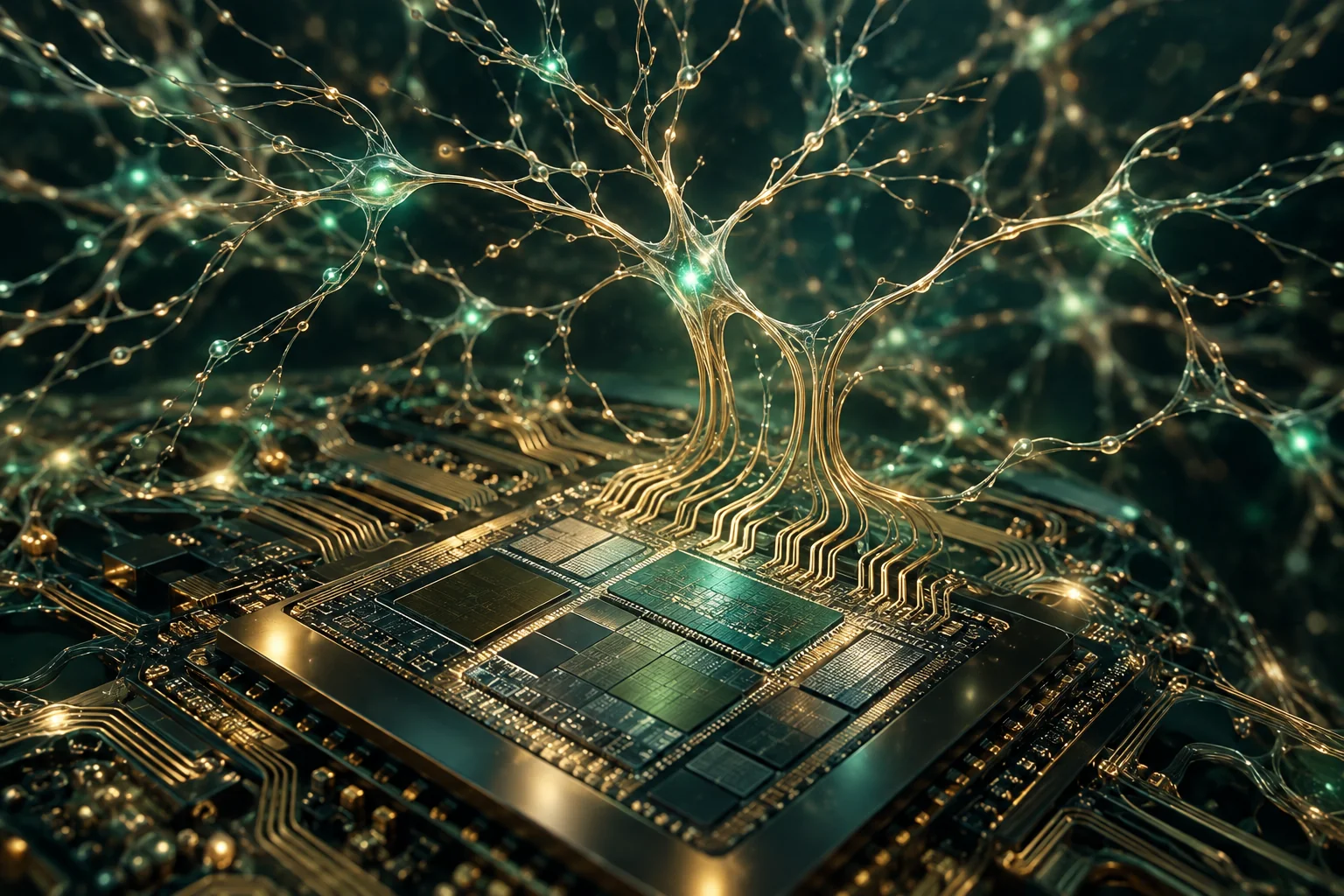
In a spiking network, electronic neuron models exchange discrete events. A unit accumulates input and produces a spike according to its model; configurable connections determine how that event affects other units.
These are electronic models of selected neural principles. They are not living cells, and counting them does not measure human-like intelligence.
PUBLISHED RESULT / 2014
1 million electronic neurons
Researchers presented a neuromorphic chip with one million programmable spiking neurons and 256 million configurable synapses. The result demonstrated large-scale electronic implementation of this architecture.
For a defined workload, can event-based processing offer a useful balance of accuracy, latency and energy use? A fair comparison needs the same task and actual hardware measurements.
An elegant browser animation cannot establish chip efficiency. The advantage must be measured in the intended system.
OUR PROPOSED EXPERIMENT
Compare an event-triggered processor with a continuous baseline on the same recorded or synthetic sensor stream. Document missed events, false detections and latency before choosing specialised hardware.
02 / MICROFLUIDICS & ORGAN MODELS
A small environment. A biological question.
A chip can also be a carefully controlled environment around living cells. Tiny channels, membranes and fluid flow let researchers study selected functions of tissue.
MICROFLUIDICSTISSUE MODELSCONTROLLED FLOW
02 / BIOLOGY IN A CONTROLLED SPACE
THE MECHANISM
Channels around living cells
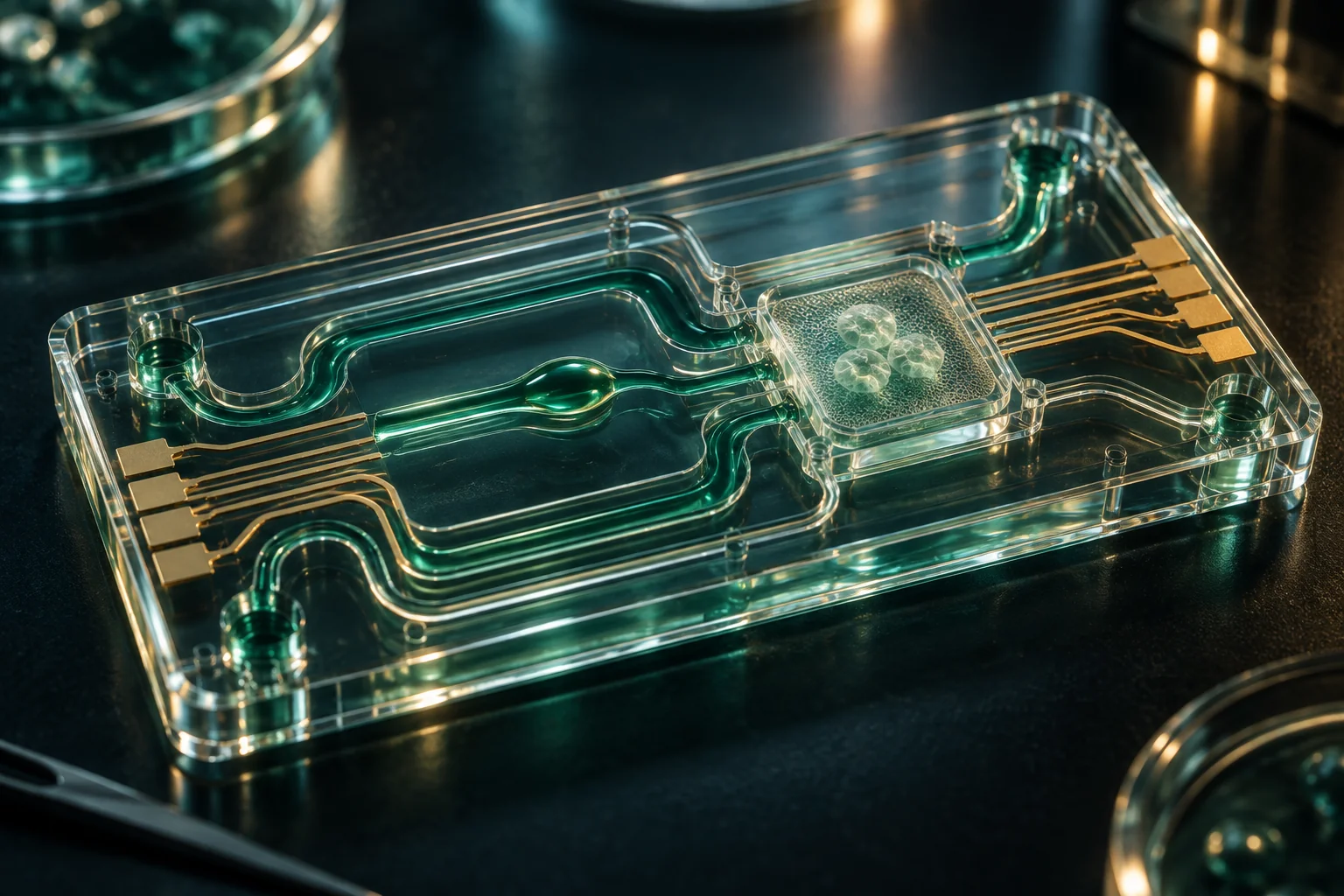
Microfluidic channels guide small fluid volumes. In some organ-on-chip systems, cells grow on a flexible membrane, with controlled exposure to flow, chemicals or mechanical forces.
The purpose is to reproduce a selected tissue function well enough to investigate a defined question. A chip of this kind is not a complete or transplantable organ.
PUBLISHED RESULT / 2010
A breathing lung model
A study recreated the interface between human lung alveoli and capillaries in a microfluidic model. Human cells and mechanical stretching mimicked aspects of breathing; the model reproduced responses to bacteria and inflammatory signals.
Cell type, membrane, flow and mechanical forces all shape the result. Researchers need to establish which observations transfer to the biological system and which remain properties of the laboratory model.
More complexity is useful only when it improves the answer to the question being tested.
OUR PROPOSED EXPERIMENT
Begin with a non-biological flow demonstrator or simulation. Compare predicted and observed flow and document the sensor connection. Cell culture would belong to a separate future research programme.
03 / BIOLOGICAL MODELS & DIGITAL TWINS
A model with something to answer to.
A digital model becomes useful when it can be compared with a measured system. Its purpose is to answer a question, expose assumptions and make predictions that can be tested.
COMPUTATIONAL MODELSVALIDATIONUNCERTAINTY
03 / MEASUREMENT ↔ MODEL
THE MECHANISM
Observe, parameterise, predict
Geometry, measurements and explicit assumptions can define a computational model. Selected parameters are fitted to data; predictions are then checked against observations that were not used for fitting.
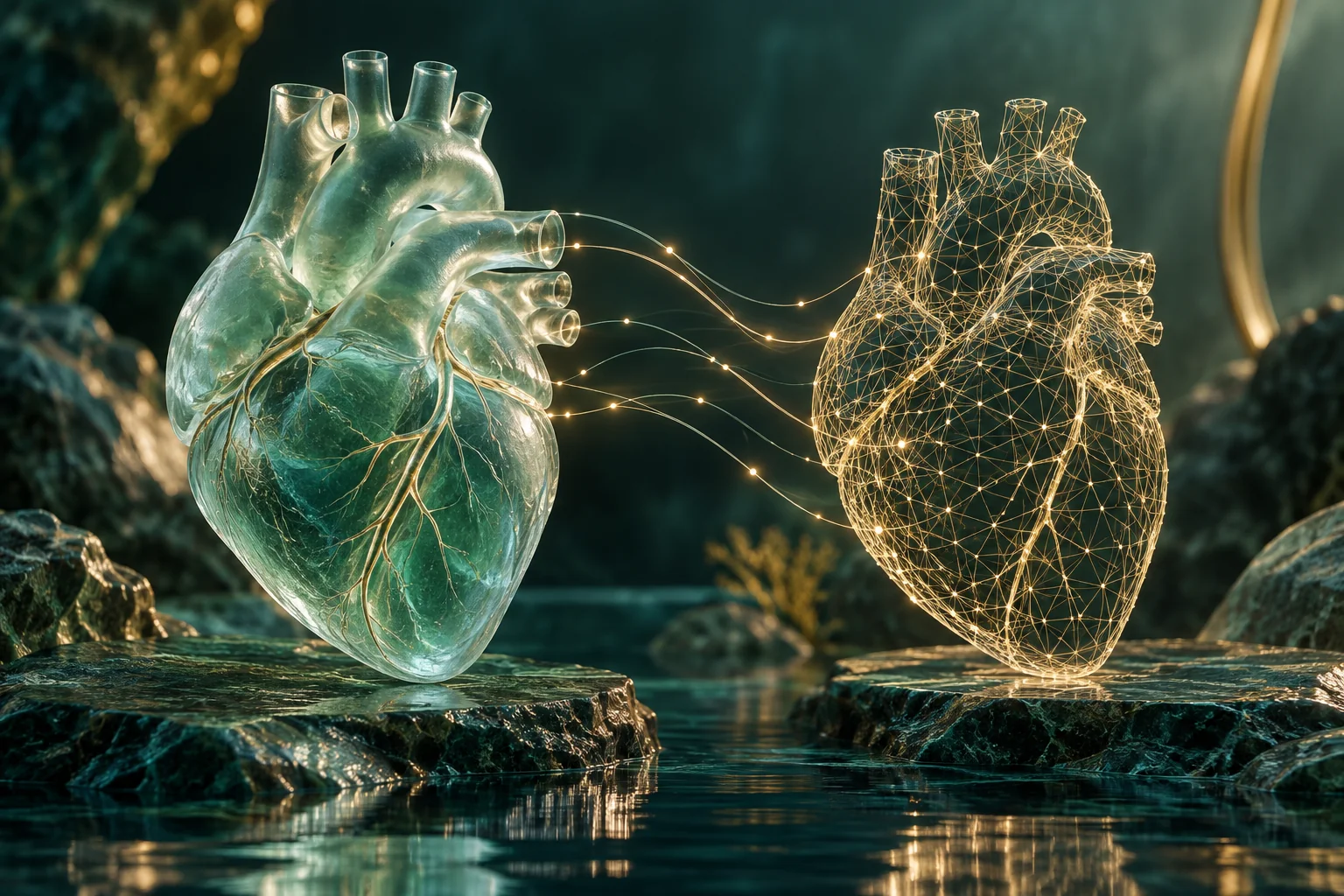
The term digital twin needs a defined physical counterpart and a clear account of how measurements update the model. A visual replica alone does not establish that relationship.
PUBLISHED RESULT / 2018
Personalised virtual hearts
Virtual-heart models were evaluated to identify ablation targets for infarct-related ventricular tachycardia. The study used retrospective data from 21 patients and a prospective feasibility study with five patients.
How well does the model describe data it has not already seen? Its uncertainty, update process and applicable range matter as much as the visual result.
The cited small feasibility study concerned a specific clinical task. It did not create a complete human replica or establish universal outcomes or real-time whole-body monitoring.
OUR PROPOSED EXPERIMENT
Model one measurable signal process using synthetic or suitable open data. Fit one segment, test predictions on another and report the error. Keep it labelled as a demonstrator until its connection to a measured system is established.
04 / HAPTICS & HUMAN INTERACTION
The connection comes back to you.
A system becomes an interaction when information returns to the person. A visual cue, a vibration or a tactile sensation can help someone understand the effect of an action.
HAPTIC FEEDBACKCLOSED LOOPHUMAN AGENCY
04 / ACTION → FEEDBACK → HUMAN
THE MECHANISM
Close the perception–action loop
A person acts, the system detects a change and an output conveys what happened. Haptic interfaces communicate through touch; different technologies use vibration, force or other forms of stimulation.
An external vibration device and an implanted neural interface are different technologies with different capabilities. The illustration shows an external concept; the cited study used implants.
PUBLISHED RESULT / 2021 · ONE PARTICIPANT
20.9 → 10.2 seconds
Median robotic-arm task time fell from 20.9 to 10.2 seconds when one participant with tetraplegia received tactile feedback through an implanted brain–computer interface, in addition to vision.
Does the feedback improve the selected interaction across users, tasks and longer use? Timing, comfort, false signals and the ability to disengage all need attention.
The cited task result does not demonstrate general intelligence enhancement or predict the performance of a future vibration wearable.
OUR PROPOSED EXPERIMENT
Explore a non-invasive visual or haptic demonstrator for one clearly defined interaction. Start with a bench test of timing and repeatability; any later usability study needs its own appropriate participation arrangements.
INTERACTIVE / CONNECT THE STEPS
Build a signal chain. Understand every link.
Choose a scenario, then explore its four stages. The examples show what enters a system, what comes out and what needs to be checked before moving on.
Movement signal / 01
From movement to a time series
An external motion sensor could record acceleration over time. Begin with a defined movement on a test rig and document sensor placement.
Can the same controlled movement be recorded consistently?
INPUT
Acceleration and timestamps
OUTPUT
A time series with units and sampling rate
WHAT TO CHECK
Sensor placement, saturation and repeatability
An educational pathway explorer. It does not connect to a sensor, analyse a person or produce a medical result. All scenarios are proposed examples, not installed Nano Genetics systems.
DEVELOPMENT / FROM A QUESTION TO EVIDENCE
A wider horizon. A focused first experiment.
These fields guide the long-term direction. Our proposed immediate work is to choose one limited, non-clinical signal pathway and make its performance reviewable. We have not yet selected a final sensor, budget or delivery date.
01 / DEFINE
Choose the question
State the signal, intended interaction and conditions in which an observation would count as useful. Choose a simple reference for comparison.
Output: a scoped experiment brief.
02 / CONNECT
Build the smallest chain
Connect input, timestamps, a basic processing step and a visible output. Keep the data path documented from the beginning.
Output: a documented bench demonstrator.
03 / COMPARE
Measure the difference
Repeat the same conditions, vary one factor at a time and compare against the reference. Report failures and missing data alongside successful runs.
Output: results, limitations and test data.
04 / DECIDE
Let the result guide the next step
Decide whether to improve the demonstrator, choose another method or stop. More complex hardware should follow a demonstrated need.
Output: a reasoned decision and updated plan.
This extends the first sensor-to-human prototype direction introduced in Human Interface.
Open a term for a short explanation. Similar words can describe very different technologies; the distinctions help us ask better questions.
Neuromorphic computing
Computing architectures inspired by selected principles of nervous systems, such as event-driven communication. An electronic neuron model is a mathematical and physical implementation, not a living neuron.
Spiking neural network
A network in which model neurons communicate with discrete events called spikes. The timing and connections influence how input changes the network's state and output.
Microfluidics
Methods for controlling small fluid volumes in narrow channels. They can help define flow, mixing and exposure conditions in experiments.
Organ-on-chip
A laboratory model that combines living cells with a controlled microenvironment to reproduce selected tissue or organ functions. It is not a complete replacement organ.
Digital twin
A digital representation linked to a defined physical counterpart, with an explicit way to update it from observations. Its scope and validation determine which questions it can answer.
Model validation
Checking whether a model is adequate for its intended use by comparing predictions with suitable evidence, including data not used to fit the model.
Haptic feedback
Information conveyed through the sense of touch, for example a vibration or force. The pattern must have a meaning the person can learn and distinguish.
Closed loop
A sequence in which a measurement or action changes an output, and the effect is observed again. The feedback can guide the next action; its timing and reliability matter.
Latency
The time between an input and the relevant response. In an interactive system, measure the whole path and its variation, rather than only the model's calculation time.
Baseline
A simple, clearly described reference method used for comparison. A more complex model earns its place when it improves a relevant result under a fair comparison.
READ THE ORIGINAL WORK
The evidence has a source.
The four studies below are primary publications by independent research teams. Their results belong to the systems, tasks and participants described in each paper.
01 / SCIENCE · 2014
A million spiking neurons on a chip
Merolla et al. A million spiking-neuron integrated circuit with a scalable communication network and interface.
Atlas reviewed September 2026. Publication dates identify the original results; this selection illustrates mechanisms and does not claim to be a complete review of each research field.
BIOLOGY × COMPUTATION × HUMAN
Build understanding. Then build the connection.
Help turn a focused question into a reviewable experiment. Explore the development plan, support the company or contact us with a concrete idea for collaboration.