Six channels. A shared clock.
Three acceleration axes and three angular-velocity axes describe different components of movement. Time alignment makes their relationship usable. An IMU alone does not measure intention.
 NANO GENETICSSWEDEN AB
SV ↗
NANO GENETICSSWEDEN AB
SV ↗
CHAPTER 05 / HUMAN SYSTEMS
A meaningful system starts with a human question. Then comes the sensor.
Our direction is to connect external sensing, local computation and understandable feedback. Explore two design concepts, then build a first signal budget for your own experiment.
Open System Studio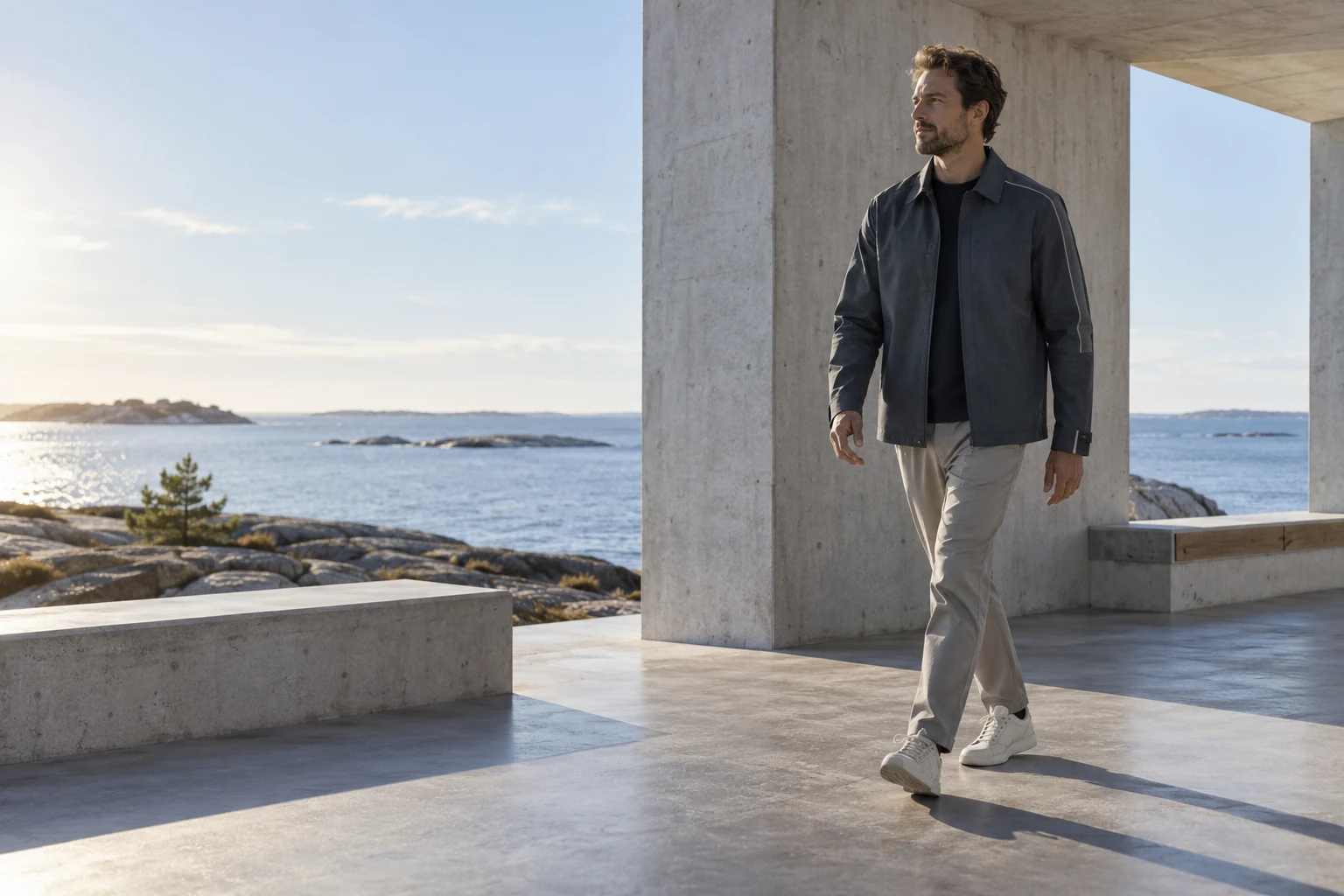
DESIGN DIRECTION / OUTSIDE THE LAB
A step on a staircase and a movement of the wrist can look very different to the same sensor.
An inertial measurement unit, or IMU, combines acceleration and angular velocity. It can describe aspects of motion, but interpretation depends on placement, orientation and the task. A signal gains meaning when it is compared with a defined reference.
Three acceleration axes and three angular-velocity axes describe different components of movement. Time alignment makes their relationship usable. An IMU alone does not measure intention.
Use a known movement on a bench rig. Repeat it with different sensor orientations, compare timestamps and record drift. Then define a voluntary, non-clinical usability study before testing a wearable concept with people.
A future interface could show a simple motion event and its uncertainty. The person should be able to correct it, pause it and understand what was actually measured.
DESIGN DIRECTION / COMPUTATION CLOSE BY
Keep the first interpretation close to the signal. Decide deliberately what needs to leave the device.
Our concept combines a textile interface, a removable sensing module and local processing. The exploded view is a design exploration. The proposed architecture must still be built and evaluated for power, heat, contact quality and comfort.
Make the assumptions visible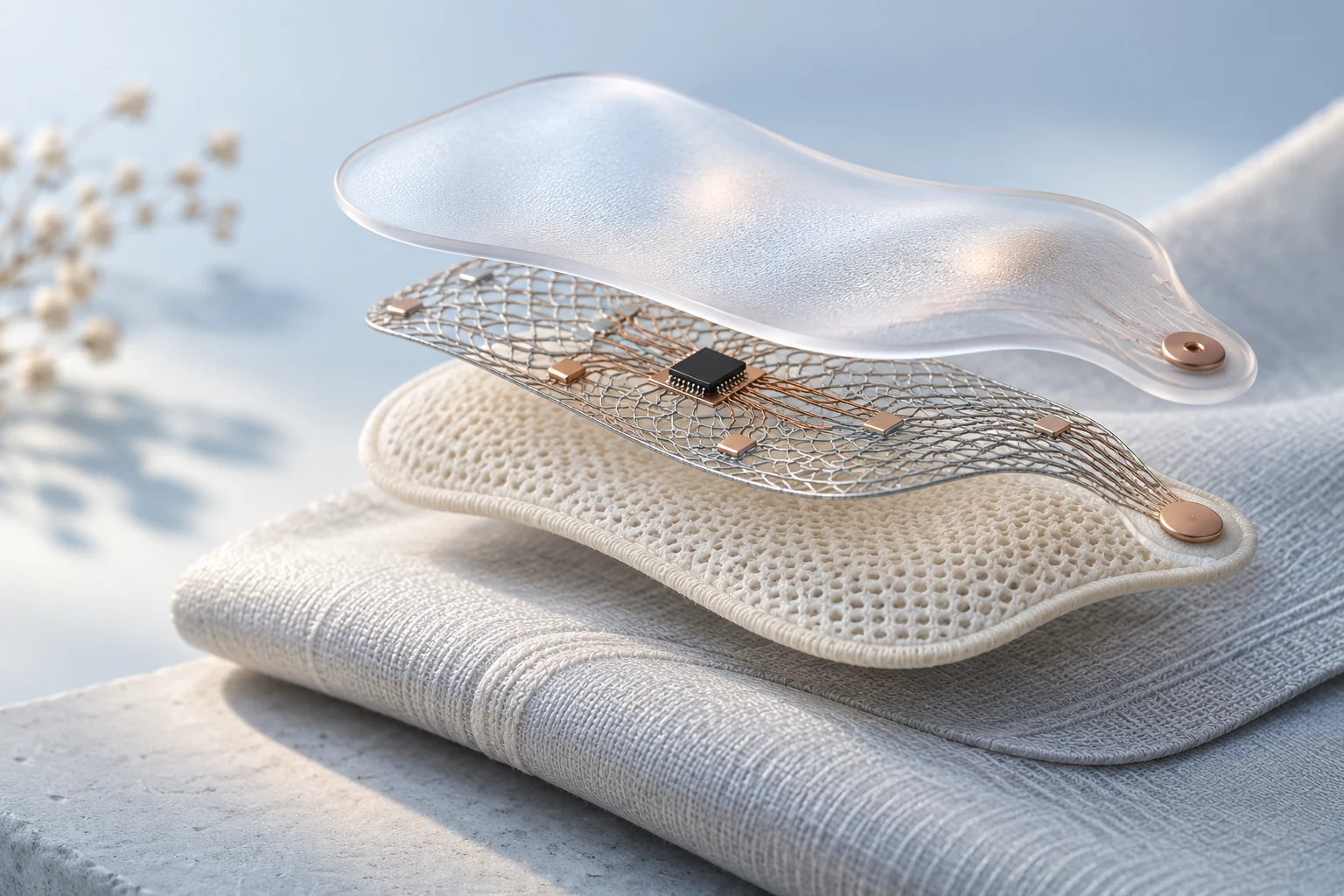
Start with a specific question and the smallest useful set of signals. More channels also create more data to explain and protect.
A proposed bench test would measure acquisition, processing and transmission separately. Data volume alone cannot predict battery life or response time.
The wearer needs an understandable state, a clear pause control and a choice about data retention. Local computation is one design choice, not a complete privacy guarantee.
INTERACTIVE / SYSTEM STUDIO
Choose a question, combine signals and set a recording length. See the raw data budget, the limitations and the tests your concept would need. Save the result as a brief.
Show a possible movement event with uncertainty. Let the person confirm, correct or pause.
(6 × 100 × 16 / 8) × 600 = 720,000 bytes
Raw payload = sum of channels × samples/second × bits/sample ÷ 8. Recording volume = raw payload × seconds. 1 KiB = 1,024 bytes; 1 MiB = 1,048,576 bytes.
These are illustrative, fixed planning assumptions, not clinical acquisition settings. The environmental example assumes one temperature channel and one ambient-light channel. Each channel stores a 16-bit value. Timestamps, packet headers, storage format, compression and other overhead are excluded.
The studio calculates a data budget. It does not estimate battery life, model accuracy, latency or clinical benefit. No sensor is connected and no personal signal is collected.
Save the configuration, exact calculation and proposed tests.
THE NEXT STEP / A PROPOSED DEVELOPMENT SEQUENCE
One use case. One reference. A written measure of success.
Characterize the signal and its failure cases before a richer model.
Explore comfort, clarity, control and the ability to stop.
Report the method, limitations and result. Let evidence guide the next step.
RESEARCH CONTEXT
Published work informs our questions. The concepts and calculator on this page are independent design explorations; the studies below do not describe Nano Genetics products.
A 2025 study combined a wristband with surface electrodes and models trained across many participants to decode wrist movements, finger gestures and handwriting. New users could use the models without individual calibration in the studied tasks. This was interaction based on muscle activity, not mind reading.
Read the original studyResearchers integrated sensors, memory, processing and communication into an elastic fibre. In a demonstration, four fibre computers in a garment classified physical activity using local neural networks. Combining their predictions improved the result compared with individual fibres. This was an experimental demonstration, not medical validation.
Read the original study